- Is the earth warming?
- How do we measure it?
- What does the data say?
- Where does the data come from?
- How is the data processed?
- Who collects/processes/interprets the data?
Who collects/processes/interprets the data?
There are four data sets that are widely used to study earth's temperature.
1. HadCRUT4 is produced jointly by the UK Met Office Hadley Centre and the University of East Anglia's Climatic Research Unit.
2. GISTEMP is collected by NASA Goddard Institute for Space Sciences (GISS).
3. MLOST is compiled by the National Oceanic and Atmospheric Administration (NOAA).
4. The Japan Meteorological Agency (JMA) creates one too, but I don't know what it is called.
They do the collection and most of the processing. They of course do a lot of interpreting too, but a lot of other people use their data.
How do we measure global temperatures and where does the data come from?Temperatures are measured through a combination of ground stations, buoys (for water temperature) and satellite data. I don't know exactly why water temperatures are included, but they are. That gives us a temperature map of earth.
However, the way they come to the graph below is through a process of determining anomalies and averaging them to produce the graph below which comes from NASA and is a integration of all four data sets mentioned above. This process is not trivially simple and I don't understand it yet. I will see if I can get my hands on the actual data and reproduce their numbers.
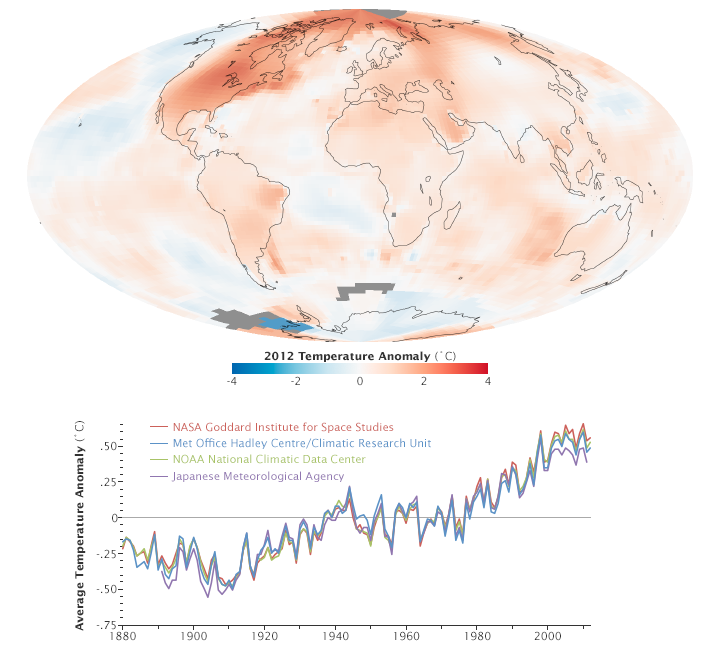
What the data say? Is the earth warming?
Well, according to the graph of the data NASA provided above it is. Over the past 130 years the global temperature has increased a little short of one degree Celsius. There you have it folks! Global warming is a thing. Well, maybe.
I like data analysis so I am going to try to find the raw temperature data and learn more about how the come up with the numbers. Not that I doubt them, it is NASA after all, but I was expecting something a little more straight forward and I don't understand the anomaly method they use.
Since that will probably take longer than a day I am going to move on for now and take the easy (and probably legitimate) way out and just say they are correct for purposes of the next round of questions.
My Conclusion
The data seems to show warming. Not nearly as much as I expected given the size of a deal everyone seems to be making out of it. So that is surprising. Let's say the average temperature is 50F. That means that the change shown above is about a 0.3% variation in absolute temperature (K). Now, there are a lot of questions I still need to ask, but that seems like a really small variation given normal yearly temperature fluctuations exceed 80 K which translates to over 25% temperature fluctuation.
So does that 0.3% pose an existential threat? Maybe it does, but my engineering brain says that if the system that is our planet was so unstable as to risk collapse over a couple percentage points we would never have been around in the first place.
I don't want to be too skeptical though. Admittedly I do not understand this topic well so I truly cannot make any final judgements at this point.

No comments:
Post a Comment